

President Donald Trump recently referred to Senator Jon Ossoff as a “communist,” a “Marxist,” and even compared him to Pee-wee Herman during a speech in Georgia. Whether you support Trump or Ossoff isn’t really the point.
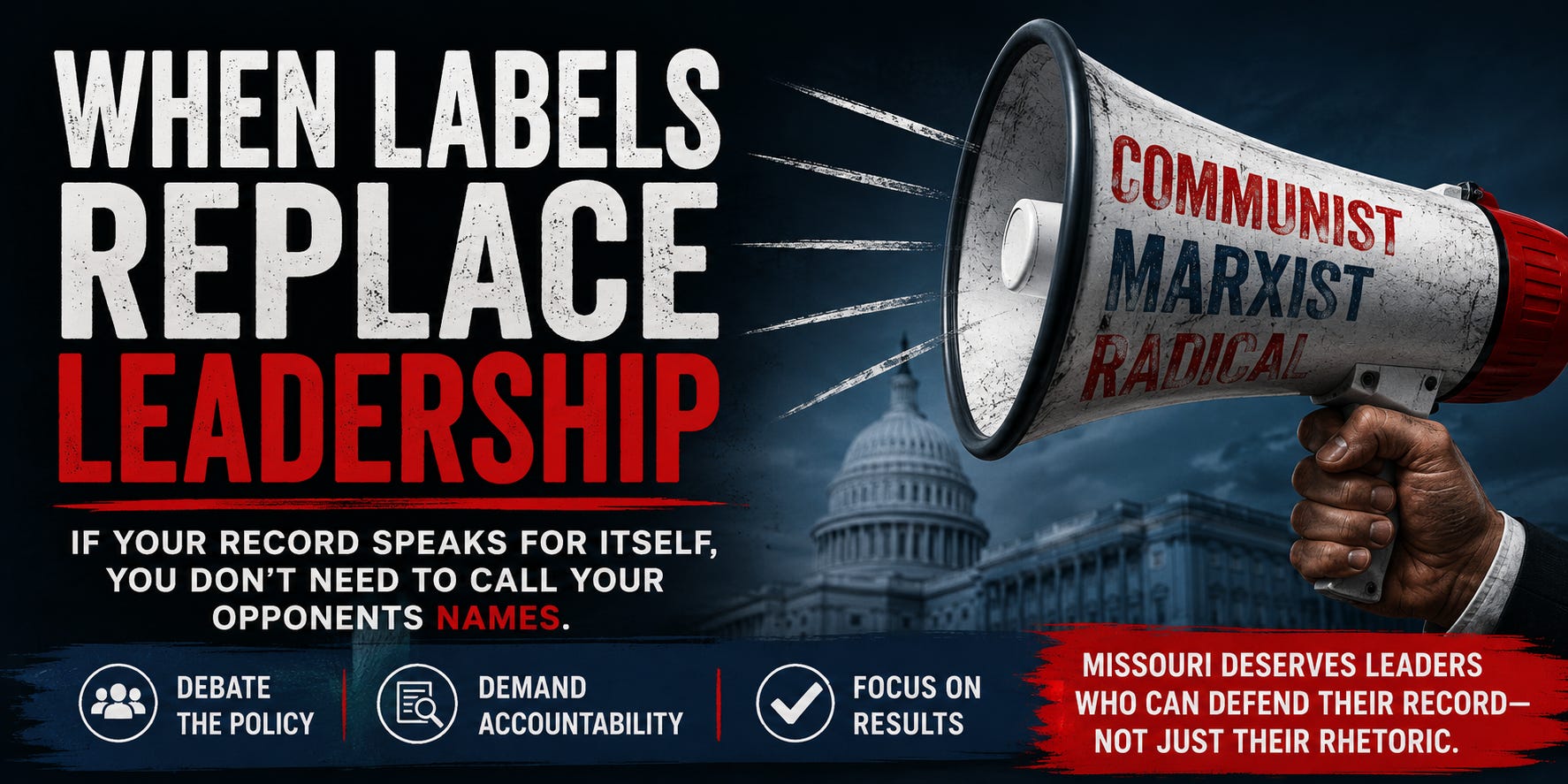
The point is what this style of politics has become.
When politicians can’t defend their record, they reach for something easier: labels.
“Communist.”
“Marxist.”
“Radical.”
We’ve all heard them. They have become the political equivalent of pulling a fire alarm. Rather than debating ideas, discussing evidence, or defending a governing record, these labels are used to end the conversation before it begins.
Why?
Because it’s much easier to make people afraid than it is to solve difficult problems.
It’s easier to throw around ideological buzzwords than explain why families are still struggling to make ends meet. Easier than addressing why healthcare costs continue to rise. Easier than confronting stagnant wages, underfunded schools, or communities that feel left behind.
Name-calling isn’t an argument.
It’s a distraction.
Missouri Is a Perfect Example
Here in Missouri, Republicans have held a legislative supermajority for more than 22 years.
That’s not a temporary majority. That’s not shared responsibility. That’s more than two decades with the power to shape the state’s priorities, write the budgets, pass the laws, and claim credit for success.
Which also means they own the results.
If Missouri is thriving, they deserve recognition.
But if Missouri continues to struggle with teacher shortages, rural hospital closures, low wages, workforce challenges, and declining trust in government, voters have every right to ask why.
Those aren’t partisan questions.
They’re accountability questions.
Instead of welcoming those questions, too many politicians respond by attacking the people asking them.
Critics become “radicals.”
Reformers become “socialists.”
Anyone who challenges the status quo becomes “anti-Missouri.”
None of those labels answer the question.
Debate the Policy, Not the Person
If someone supports universal healthcare, explain why it’s a bad idea.
If someone wants to strengthen public education, make the case for a different approach.
If someone argues for campaign finance reform, show why your alternative is better.
That’s what democracy is supposed to look like.
Healthy democracies depend on competing ideas—not competing insults.
Labeling someone doesn’t refute their argument.
It simply avoids having one.
Accountability Is Not Extremism
One of the most troubling trends in American politics is that asking elected officials to defend their record is increasingly treated as an act of disloyalty.
It isn’t.
Questioning government is one of the most patriotic things a citizen can do.
Holding elected officials accountable isn’t radical.
Expecting better results isn’t socialism.
Wanting affordable healthcare, quality public education, honest government, and an economy that works for working families isn’t communism.
It’s citizenship.
Leadership Requires More Than Rhetoric
Real leadership doesn’t depend on fear.
It doesn’t require caricatures or personal insults.
It doesn’t ask citizens to stop asking questions.
Real leadership welcomes scrutiny because confidence comes from results.
If your ideas are better, make the case.
If your policies are working, show the evidence.
If your record deserves another chance, explain why.
But don’t expect voters to accept labels in place of leadership.
Missouri—and America—deserve something better than politics built on fear and division.
We deserve leaders who trust the people enough to have an honest debate, defend their record, and accept accountability.
Because in the end, labels don’t improve schools.
Labels don’t lower healthcare costs.
Labels don’t create better-paying jobs.
Labels don’t strengthen democracy.
Only leadership does.